by Bruno Vicenzi
Share
by Bruno Vicenzi
Share
A joint initiative across 11 Horizon Europe projects delivers a unified roadmap to bridge the gap between CRMA regulatory targets and market realities.
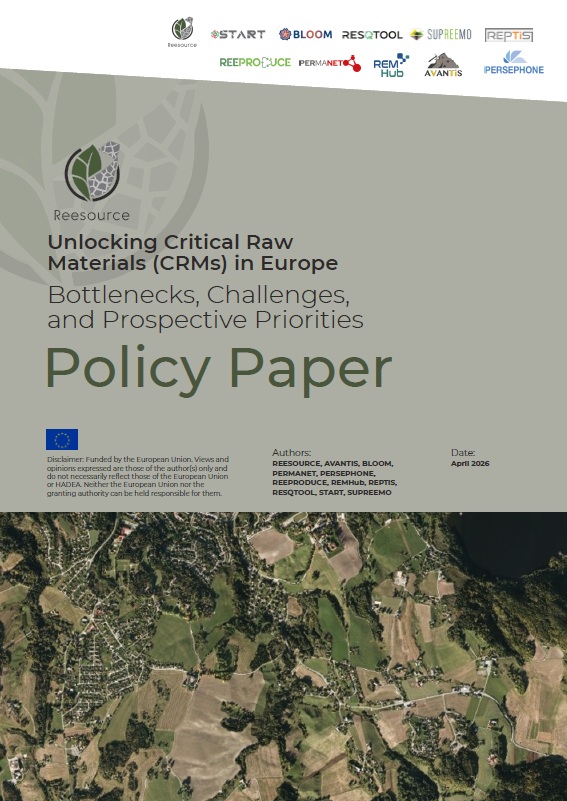
As the European Union approaches the critical five-year countdown to its 2030 climate and digital milestones, translating the ambitions of the Critical Raw Materials Act (CRMA) into operational industrial delivery remains a complex challenge. To address these systemic friction points, RESQTOOL, in close collaboration with ten fellow Horizon Europe Projects (coordinated by the REESOURCE project), has co-authored a high-level Policy Brief and an analytical Policy Paper titled:
“Unlocking Critical Raw Materials (CRMs) in Europe: From CRMA Targets to Industrial Delivery.”
This collaborative policy brief synthesizes extensive empirical evidence gathered from cross-sectoral stakeholders during the Raw Materials Week 2025 side event “Crossroads of Innovation: Shared Challenges and Joint Solutions in Raw Materials”, held on 21st November 2025. The core thesis of the publication shifts the paradigm away from geological scarcity, demonstrating instead that Europe’s primary vulnerabilities lie within institutional, financial, and logistical bottlenecks that stall technological scaling.
Strategic Focus:
For projects like RESQTOOL, focused on advanced solutions and efficiency within the raw materials value chain, the policy brief underscores a vital reality: laboratory-proven innovations risk entering the “valley of death” unless systemic market barriers are urgently dismantled.
The joint publication outlines six prospective priorities designed to structurally secure European strategic autonomy:
- De-risk industrial scale-up: Deploying blended financing mechanisms (combining public grants with de-risking guarantees) to support First-of-a-Kind industrial plants amidst volatile global commodity pricing.
- Regulatory fragmentation: Harmonizing regional waste classifications to enable seamless cross-border transport of secondary raw materials, unblocking regional circular economies.
- Enforcing advanced traceability: Introducing mandatory, standardized data protocols and information requirements for permanent magnets to foster a robust secondary market – and RESQTOOL wants to do the same for hardmetal products.
- Permitting and administrative uncertainty: Strengthening the technical and administrative capacities of national competent authorities to ensure predictable, fast-tracked permitting timelines.
- Exploration and data constraints: Mandating large-scale industrial actors to systematically catalogue and share harmonized data regarding tailings and metallurgical residues.
- Social and community alignment: Implementing early-stage, transparent, and mutually beneficial community engagement models to mitigate social opposition and prevent lengthy project litigations.
By integrating these strategic dimensions, the RESQTOOL consortium continues to align its research outputs with the broader European legislative framework, ensuring that technological innovation directly translates into resilient, sustainable, and self-sufficient industrial value chains.
The comprehensive Policy Brief and the underlying Policy Paper are available for academic and professional consultation via the repository links below (Zenodo).
Policy Paper: Policy Paper-Unlocking Critical Raw Materials (CRMs) in Europe: Bottlenecks, Challenges and Prospective Priorities
Policy Brief: Unlocking Critical Raw Materials (CRMs) in Europe: From CRMA Targets to Industrial Delivery